This is posts page. All of your news or blog posts should be listed on this very page, regardless the category they belong to. Posts page can have its own header image, owh crap, whatta nice, handy feature. WordPress is awesome.
In order to make Posts page “active”, select Settings > Reading from admin dashboard then be sure to tick select A static page radio button option. Use drop-down to navigate to this page.
Dermoid Sinus in the Rhodesian Ridgeback – 1
By Diane Jacobsen 4561 Todd Road Sebastapol, CA 95472-5227 dijs@aol.com
(These two articles are also located on the RRCUS site at www.rrcus.org)
The dermoid sinus (D.S.) has been known by many names, a few of which are dermoid cyst, hair cyst, and African cyst. It is a sinus, in that it is tubelike and does drain, and dermoid because it is skinlike. It may or may not contain hair follicles or be lined with hair. As the hair sheds on the outer coat of the pup, so does the hair inside this tube. The body’s natural response to dead material is to flush it out and thus the serum builds up and expels the debris., Not all of the dermoid sinuses are true tubes. Some are not hollow and the serum and debris cannot drain. In these cases an abscess forms and the resulting swelling that accompanies can rupture the skin. This results in a very painful situation for the pup. At its worst it is life threatening.
The D.S. is generally found on the midline of the neck, back, and tail along the spinal column. Although rarely found in the ridge there have been several cases noted. Dermoid sinuses have also been noted on ridgeless puppies.
The D.S. is a congenital condition, meaning that it is present at birth. It can be palpated on the newborn pups, and the affected pups identified. The affected pups should be put to sleep or if they are to be kept, surgery to remove the D.S. should be performed before sending them to their new homes. The affected pups are pet stock only and should not be considered as breeding material.
To find the D.S. you must palpate along the midline of the spine, starting at the top of the head close to the occiput (bump) bone. To do this you may pick the pup up and hold it in the cup of your hand or palpate as the pup is sleeping. Take the other hand and envision yourself picking up a baby kitten by the scruff of the neck with your thumb and forefinger. Exert enough pressure to feel, but not enough to bruise. Use your whole hand as one unit, pulling first up toward the nose and then down toward the tail. The skin will stretch quite a bit in both directions. Do not roll the skin through your fingers. The fingers remain exactly where you placed them on the skin. The D.S., being attached on the top to the skin and at the base to the spinal cartilage, will slip through your fingers. A large D.S. will feel like a wet noodle and a finer D.S., like a small string. Reposition your fingers on the neck just below the starting spot and repeat this process. Continue to work your way down the neck and back to the tail.
At the tail it is very difficult to raise enough skin to palpate effectively. It is best to use your thumb in this area. With fingers underneath the pup supporting it, place the flat of your thumb over the spinal column at the pelvic area. Push skin first to one side and then back to the other side. Again, remember that the D.S. is attached and will slip under your thumb. This will feel like a squiggly noodle on a larger, longer D.S., or just an area that simply will not move at all on a shorter D.S. If you do not feel anything by sliding the skin from side to side, try sliding the skin toward the nose and then back to the tail, taking care to slide the skin, not your thumb.
As you palpate the area over the shoulders, you may feel connective tissue that holds the skin to the shoulder area. The tissue is heavier in this area than in the other areas of the spinal column. It will feel flat and you will not be able to trace it from the area close to the muscle all the way to the skin, whereas the D.S. is easily traced from the muscle to the top of the skin and feels round.
The D.S. can be visually detected by looking for a group of hairs that protrude straight up out of the hair coat of the pup. When you see this, the pup should be palpated for a D.S. The hair can also be shaved at this site and upon examination, a small dimple will be revealed. By moving the skin back and forth, the dimple will become more apparent as the anchor of the D.S. will pull the skin down more.
The D.S. can be surgically removed. It is advised that a vet be contacted that is familiar with this condition and has performed this operation before. Dermoid sinuses are not alike in their makeup and it is impossible to tell which ones are easily removed or which ones go to the spine. They can wrap around or enter the area of the spinal cord, which makes them almost, if not impossible, to remove. In cases such as this some success has been achieved by folding the D.S. over and tying it off, but some have had regrowth. Since there is no way to detect which type of D.S. that the pup has, instructions to the vet should include that if the D.S. is not completely removable, the pup be put to sleep. D.S. pups should not be promised to a new home until after the surgery.
The healing process can be as traumatic as the operation itself. In the simple cases that remove easily, there will be little or no serum build-up in the surgical area. In the more complicated surgeries, where the tissue damage has been more severe, the serum will start building up as soon as the surgical site heals over on the top of the skin. Usually this will be on the fourth or fifth day. This requires aspiration with a large guage needle and syringe, sometimes three or four times daily, to remove the serum build-up. This can last for three to 10 days after surgery.
Pups that have had surgery must be removed from the litter to prevent damage to the surgical site. As puppies play, they grab and shake areas of skin on the other pups. If they were to grab and shake over or near the surgical site, damage would occur and the serum buildup would become a bigger problem.
Dermoid sinuses have been detected on other parts of the body, but are not as commonly seen as on the midline of the spine. A few have been noted on the head, attaching to the skull or the base of the ear. Another area of note is on the neck under the ear or on the front of the neck. Sometimes these can be dermoid sinuses and sometimes they are skin tabs.
The exact mode of the inheritance of the D.S. is not known. It is thought to be polygenic (multiple genes), rather than simple dominant or recessive. It has been noted that there can be carriers, or individuals that produce more dermoid sinuses than their littermates. Some lines are relatively D.S. free. Dogs that are subjects of D.S. are not candidates for a breeding program. The surgery removes the visual defect but not the genetic one. Pups having had surgery to remove a D.S. are eliminated from the conformation ring as per the AKC rules, which clearly state that a dog that has been surgically altered cannot compete.
The ethics of breeding require you to put the best possible representative of the breed out there. It should not only look like a Rhodesian Rideback, but it should be as healthy and sound as possible. As the D.S. is a very serious unsoundness, much thought should be given in your decision of the disposition of a D.S. puppy. If you decide to keep and operate on a D.S. subject, care must be taken to assure the pup of a home that will spay or neuter. Euthanasia is a permanent solution.
[Note: Because of the D.S., avoid injections in the area of the top of the neck and shoulders. Occasional reactions to vaccines can produce an inflammation that resembles a D.S.]
Dermoid Sinus – A Summary by E. Clough, V.M.D. 1010 Daniel Webster Highway Merrimack , New Hampshire 03054
Introduction
Dermoid sinus (D.S.) was first used to describe the Rhodesian Ridgeback skin anomaly by Steyn, et al. This skin condition has also been called trichiasis spiralis, dermoid cyst, dermoid inclusion cyst and epidermal inclusion cyst. All of these terms have some applications; however, Dermoid, skin-like sinus, channel or fistula; (cyst means sac, i.e., not open to the surface) is most applicable. The Rhodesian Ridgeback Club of the U.S., Inc. prefers to use D.S. to describe the condition.
Description
No reports have been located which substantiate the author’s impression that D.S. has been found in other breeds. Dermoid sinus included in the ridge has been reported only once. They also occur in the sacral (rump) area and in this location are sometimes connected to the dura (spinal cord covering). This is not the case in the more common cervical (neck area) D.S. which connects the skin to the dorsal spinous ligament (the ligament which connects the top parts of the vertebrae). One or more D.S. may occur in the same animal. These sinuses are congenital (present at birth) and can be palpated (felt) as cords running between the skin and the spine. They form a small external opening which can be readily seen once the hair has been shaved.
Histologically (microscopically) the sinus is a thick-walled tube composed chiefly of fibrous tissue and lined with stratified squamous epithelium (skin cells). The surrounding connective tissue may or may not contain hair follicles, sebaceous glands and sweat glands which open into the lumen (hollow center) of the sinus. In uncomplicated cases the sinus is filled with sebum (oil), skin debris and hair. Once infected with bacteria the resulting inflammation and abscessation can lead to myelitis and encephalitis (swelling and infection of the spinal cord, its covering, and the brain). The reason for discrimination against animals with D.S. is the almost inevitable abscess which forms.
Heritability
Although not well understood, transmission of D.S. seems to be a dominant, polygenic problem with inconstant penetration. Another geneticist thinks that D.S. is due to a single completely recessive autosomal gene. This is not likely because normal parents do produce pups affected with D.S. Because of the genetic complexity and the difficulty in arranging, coordinating and collating the breeding studies necessary to prove the heredity of D.S., it is unlikely that we will be able to substantiate the exact mechanism of genetic transmission. There is a widely held belief that breeding Ridgebacks with D.S. produces an increased prevalence of pups with D.S. The R.R. Club of the U.S., Inc. believes that this could be substantiated if breeders had accurate records which could be collated and computed. It is our belief that careful controlled breeding studies would prove the inheritance of D.S. to be not only complex but also inter-related with other characteristics. Therefore, the likelihood seems to be remote that we will ever have Ridgebacks which are entirely free of D.S.
Because selective breeding will unquestionably reduce the prevalence of D.S., but probably not eliminate its occurrence, and because the condition results in difficult to treat abscesses unless surgically removed, it is our opinion and strong recommendation that dogs which have D.S. not be acceptable as show or breeding candidates. Surgical correction can be accomplished; however, culling at birth is a more humane way to handle the affected pups.
References
Antin, I.P.: Dermoid Sinus in a Rhodesian Ridgeback Dog. J.A.V.M.A., Vol. 157 No. 7, (1970): 961.
Burns, M. and M.N.Fraser: Genetics of the Dog. J.B.Lippincott Co., Philadelphia PA (1966): 84.
Juvenile Myoclonic Epilepsy Rhodesian Ridgeback Type (JME)
Juvenile Myoclonic Epilepsy Rhodesian Ridgeback Type (JME) is an inherited disorder characterized by myoclonic jerks and photosensitivity. JME in Rhodesian Ridgeback dogs is a canine equivalent to the human form of JME, with which it shares the same symptoms and age of onset. These similarities made the canine equivalent of this disorder important study model and contributed to the identification of causative mutation.
Characteristics and Symptoms
Studied affected dogs displayed frequent myoclonic jerks or twitches, which start to occur around 6 months of age. Owners of the affected dogs described the myoclonic jerks as severe startling or even resembling an electric shock. The myoclonic seizures can be triggered by visual stimuli, such as light flashes, a sudden incidence of light or flashing light on the sea waves. Photosensitivity was recognized in 35% of dogs. The twiches mostly occur when the dog is in the relaxed state, drowsy or when falling asleep or napping. Twitches can occur also during sitting, standing or walking. There were no noticed changes in the behavior. The myoclonic jerks were mostly limited to the trunk, proximal limb musculature, cervical musculature producing nodding movements of the head, and the face. The intensity can vary between events and affected dogs. After the seizure, the dogs seem confused and scared. Due to the seizures, sleep among those dogs was impaired. The frequency of the twitches can go up to 150 twitches per day. Affected dogs are usually euthanized upon owner’s request.
Genetics
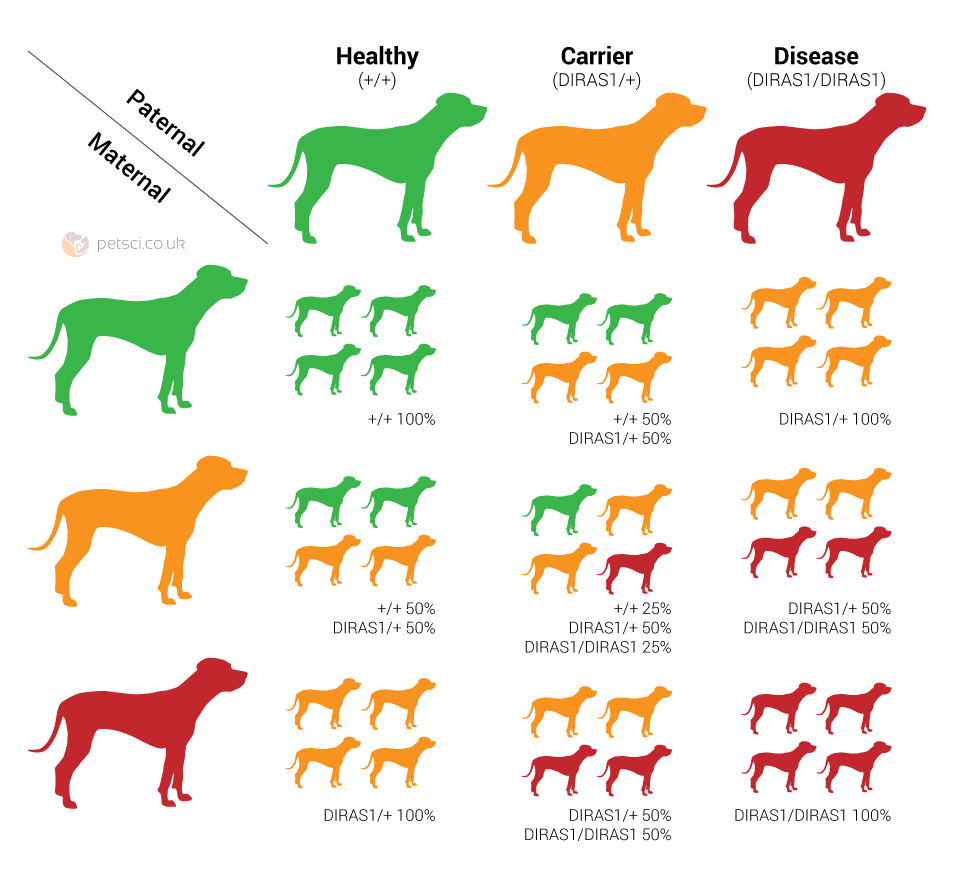
Juvenile Myoclonic Epilepsy in Rhodesian Ridgeback Dogs (JME) is caused by a 4-bp deletion in the exon 2 of the DIRAS1 gene, causing a frameshift and a loss of the stop signal. Research among other breeds affected with epilepsy revealed that this mutation is specific only for Rhodesian Ridgeback breed. A carrier rate of 15% was determined.
The expression of the DIRAS1 is limited to the brain and heart and it is suggested that DIRAS1 protein is needed for acetylcholine transmission at neuromuscular junctions and neuronal development. Nicotinergic cholinergic activity influences brain excitability and cognition, regulates the excitatory/inhibitory switch during neuronal development, stimulates glutamate release from thalamocortical terminals, and maintains nonrapid eye movement sleep by low levels of acetylcholine. Abnormal DIRAS1 function could alter cholinergic neurotransmission or formation of neuronal circuits and network assembly in the developing brain resulting in myoclonic epilepsy and photosensitivity.
Juvenile Myoclonic Epilepsy Rhodesian Ridgeback Type (JME)is inherited in an autosomal recessive pattern. Healthy parents of affected puppy are obligate heterozygotes and therefore carry one mutant allele. Heterozygotes have no symptoms. Dogs homozygous for the mutation will display the symptoms of the JME. At conception, when mating two carrier dogs, each cub has a 25% chance of being affected, a 50% chance of being an asymptomatic carrier, and a 25% chance of being unaffected and not a carrier.
Genocan & Ridgeback International Research Program Test for ridge disposition in Rhodesian ridgeback
The Rhodesian ridgeback’s distinguishing feature is the ridge of hair running along its back in the opposite direction from the rest of its coat. This characteristic is genetically determined and governed by the dominant inheritance. To understand dominant inheritance, it is necessary first to realize that every dog has inherited from its parents, two copies of each gene (one from its mother and one from its father).
Dominant inheritance means that if the puppy inherited the ridge gen just from one parent, there ridge is formed on the puppy´s back. In this case, the dog with only one ridge gene is called heterozygote (Rr). If the dog inherited ridge gene from both parents, the dog has two ridge genes, will form a ridge on the back and is called dominant homozygote (RR).
However, in the litter there may ridgeless puppies. Ridgeless puppies are born to two heterozygotes (male and female dog with only one ridge gene). Statistically, in a litter of two heterozygotes there will be born 25% ridgeless puppies .
However, according to the test results in practice, it appears that the ridge genetics in Rhodesian ridgebacks is not so simple and is characterized by incomplete manifestation of ridge gene. This means that all dominant homozygotes have ridge. Also, approximately 90% of the heterozygotes have ridge, but 10% of the heterozygotes are ridgeless. Very likely, the ridge gene is suppressed and ridge is not formed on the back. All individuals who lack ridge gene (rr) are ridgeless.
In collaboration with the Veterinary Research Institute in 2014, we have for the first time developed the genetic test, which distinguishes dominant homozygotes (two ridge genes) from heterozygotes (one ridge gene). This is the most accurate way how to predict birth of ridgeless puppies, if both parents are tested (see. Table below). Our test determines whether and to what extent there will ridgeless puppies in a litter!
Further, it was also observed the association between genetic disposition for the ridge and the occurrence of dermoid sinus. According to the research, dermoid sinus occurs approximately 5 times more often in dominant homozygotes. Our test may reduce the incidence of dermoids in Rhodesian Ridgebacks by a controlled selection of tested individuals for mating.
We have developed the genetic test, which distinguishes dominant homozygotes (R/R – two ridge genes) from heterozygotes (R/r – one ridge gene). Using our genetic test, a breeder may accuratelly predict birth of ridgeless puppies (see Table below).
Normally we has Standard and Pet Quality of the puppies. But there some more Qualities – Show Quality and Breeding Quality.
So lets look what is it mean.
Standard Quality
Rhodesian Ridgeback of cource has Breed Standard where written What dog of these breed need has and what can’t. So Standard Quality mean that these puppy not has any breed faults what is written in Breed Standard.
Standard quality not mean Show/Breeding Quality! Remember it when you looking on 8 weeks puppy. It is always risk when you taking puppy in 8 weeks or 4 months and you dream about showing or breeding!
Pet Quality
There are several cosmetic issues that automatically remove a newborn Rhodesian Ridgeback puppy from Standard Quality. None of them have any impact on the dog’s health or lovability.
Ridge faults (ridgeless, multicrowns, 1 crown, offset, short ridge)
Too much white marks on body (for example, a white “sock” on the front leg that ending upper then 5 finger)
Black color of coat
Kinky tail
Dermoid sinus
Wrong bite
Cryptorchism
You need understand that even if you looking on a puppy for just family it is not mean that you need take exactly Pet Quality puppy. Every puppy deserve on Best home! And they all want be Super Family Members! No mater on quality!
And now is the most interesting qualities.
Show Quality and Breeding Quality
I not has puppies with breeding or show quality. I has standard and pet quality puppies.
Why i has only standard and pet quality puppies? Because to me not possible do prognosis in age of 8 weeks or 4 months. Puppies are changed with age. Temper is changed with age. And of course important health checking in 2 years.
For me, the combination of words “show dog” or “breeding dog” means complex breeder + owner + dog – the great work of the breeder + the huge work of the owner + the incredible makings of a puppy. In the combination of words “the huge work of the owner” for me – the right feeding, the right vitamins, the right growth, the right socialization, the right education, and the right training in the future. Also clean tests that must be passed in 2 years (Dysplasia, elbows, back, temperament …)
So i never sell breeding or show quality puppies and never give prognosis. Because it take so long time from 8 weeks till 2 years and even 1 mistake can do dog with “big perspective” into “pet quality”.
But i know that some kennels do it.
In my opinion kennels what can give you these guaranties with 8 week puppy or even 4 month puppy lie! They are not God and can’t know everything! Not right growing puppies, wrong feeding, traumas, bad socialization and like a reason wrong temper… It is all can change promissing puppy on not promissing. And i never will trust to breeder who can say on 8 weeks puppy or 4 months puppy that he/she is super for breeding in future!!
When people ask me “we want show/breeding puppy” my answer will be “you need look in another kennel”. To me puppy with show/breeding perspectives mean:
puppy has age 6-9 month or even more
puppy has all genetick tests (JME, Dilution, Hemophilia, DM…)
puppy has “not official” x-rays and how minimum vet already say about Hd, Ed perspectives
puppy has some show marks from famous judged
puppy teeth already changed
in male both testiculard already get out and fixed in these position
VERY important is temper of the puppy!
And, of course, the price on these type of puppy quality is very big!!! But only with these qualities i can say that puppy has show/breeding quality!
Now i think you more understand in Qualities of Rhodesian Ridgeback! But i always open to speak and answer on many questions!
Hanna Dymytrova-Kaihila
Rhodesian Ridgeback Kennel from 2009
“Maanhaar Primo-Creatus”
Normally we has Standard and Pet Quality of the puppies. But there some more Qualities –... Continue
Rhodesian ridgebacks can have one of two nose colours: black or brown (usually referred to as “liver”). The eye colour should be in line with the colour of the dog: the liver nose should be accompanied by an amber eye colour; the black nose should have a dark eye colour. Liver noses can vary in the intensity of their nose pigment, from a deep brown to a light, almost pinkish color. Both – black nose and liver nose – are correct according to the standart of the breed.
Parents give to their offspring one of the two alleles from each parent. The set of alleles for a given organism is called its genotype, while the observable traits of the organism are called its phenotype. If two alleles of a given gene are identical, the organism is called a homozygous; if instead the two alleles are different, the organism is heterozygous. When organisms are heterozygous at a gene, one allele is called dominant as its qualities dominate the phenotype of the organism, while the other allele is called recessive as its qualities recede and are not observed. Concerning noses of ridgebacks, black color is dominant, while liver is recessive.
The livernose is seen less often than black nose simply because it is a recessive feature. Both parents must have the liver gene and pass it on to their progeny in order to produce livernosed puppies. Black nosed ridgebacks can produce liver puppies if they carry a copy of the liver gene along with the dominant gene for black; to produce livernose puppies, they must be bred to either a livernose or another heterozygous black nose – that is, one that also carries the livernose gene. Two homozygous black nose ridgebacks will not produce liver puppies.
Rhodesian ridgebacks can have one of two nose colours: black or brown (usually referred to as... Continue
The ridge is the characteristic feature of the breedof Rhodesian ridgeback. The ridge is a strip formed by the hair growing in the opposite direction to the rest of the coat. A ridgeback’s ridge is always there – from birth on. Ridge does not grow in over time nor is it only present when the dog is excited or otherwise stimulated.
Genetics
Current research shows,that the ridge is a dominant trait – that is, only one parent needs to have a ridge in order for it to be passed down to offspring. Ridgeless Rhodesian ridgebacks don’t carry the ridge gene at all, and cannot produce ridged offspring. If a ridgeback has a ridge, he is either carrying two copies of the ridge gene (homozygous), or just one copy (heterozygous). In both cases the dog will have a ridge. In general, not having a ridge is the normative state in dogs, while the ridge gene is a dominant mutation that makes the ridged dogs different.
Types of the ridge
The ridge should start immediately behind the shoulders with the widest part and taper evenly towards to the hips and it should contain two identical whorls (crowns) directly opposite each other. The lower edge of the whorls should not extend further down the ridge than one-third of the ridge. There may, or may not, be a ‘box’ above the whorls and the box may vary in shape from dog to dog; any shape is acceptable.Sometimes dogs get extra whorls or less than two whorls – these dogs are not “show-quality” but they are still true ridgebacks by their nature.
Correct ridge types
Incorrect ridges
Short history
The ridgeback’s ancestor, the Hottentots’ dog, had one unusual feature that set it apart from all other dogs and it gave this characteristic to ridgebacks – that was a ridge of hair that ran down its spine, the hair turned forward in the opposite direction than the rest. Several lesser-known breeds also have a ridge the Thai Ridgeback and the Phu Quok Dog. What the connection was, if any, has been lost in the passage of time.
The ridge is the characteristic feature of the breed of Rhodesian ridgeback. The ridge is a strip... Continue